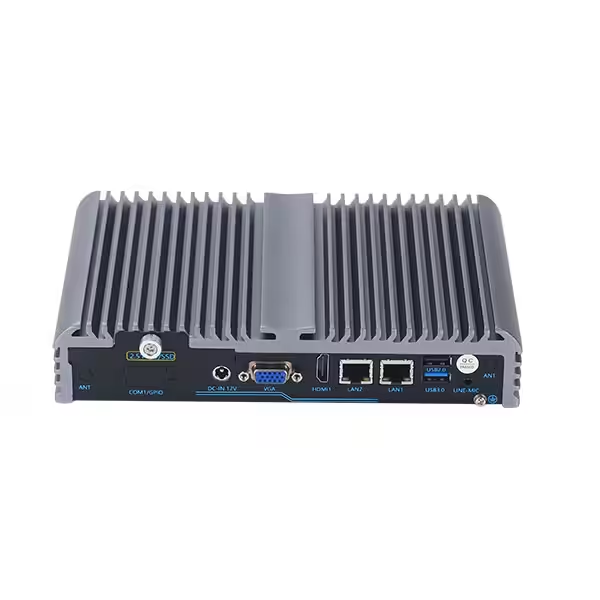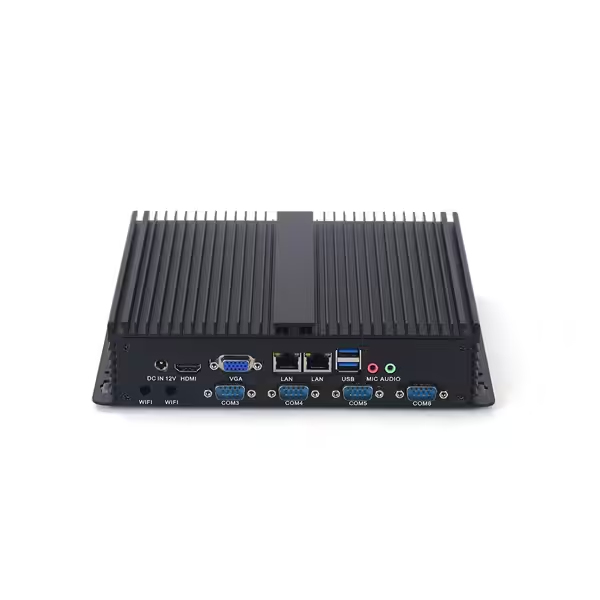
In industrial environments — on factory floors, production lines, and outdoor installations — standard desktop computers simply cannot survive. Coolant mist, metal dust, high-pressure wash-downs, and temperature extremes will destroy conventional hardware within weeks.
That’s where IP-rated industrial PCs come in. The IP (Ingress Protection) rating, defined by international standard IEC 60529, provides an objective, universally recognized measure of how well an enclosure protects electronic equipment against solid particles (dust) and liquids (water). Understanding this rating system is essential for engineers, procurement managers, and system integrators specifying rugged computers for harsh conditions.
This guide covers everything you need — from decoding the IP numbering system to selecting the right industrial panel PC for your specific application.
What Is an IP Rating for Industrial PCs?
An IP rating (Ingress Protection rating) is a two-digit classification system published by the International Electrotechnical Commission (IEC) under standard IEC 60529. It defines the level of protection that a mechanical enclosure provides against:
- Solid particles — dust, metal shavings, and fine powder
- Liquids — dripping water, spray, jets, and full immersion
- High-pressure steam (in the case of IP69K)
When you see IP65, IP67, or IP69K on an industrial computer’s datasheet, those digits are not marketing claims — they are the result of standardized, third-party laboratory testing.
Without an IP rating, terms like “waterproof” or “dustproof” carry no technical weight. An IP certification gives buyers verifiable, legally testable protection levels they can rely on when specifying hardware for mission-critical deployments.
How to Read an IP Rating — The Two-Digit System
The format is always: IP + [First Digit] + [Second Digit]
Each digit is independently rated on its own scale.
First Digit — Solid Particle Protection (0–6)
| Digit | Protection Against Solids |
|---|---|
| 0 | No protection |
| 1 | Objects larger than 50 mm |
| 2 | Objects larger than 12.5 mm (fingers) |
| 3 | Objects larger than 2.5 mm (tools, wires) |
| 4 | Objects larger than 1 mm (small tools) |
| 5 | Dust protected — limited ingress, no harmful deposit |
| 6 | Dust tight — complete, zero ingress |
Second Digit — Liquid Ingress Protection (0–9K)
| Digit | Protection Against Liquids |
|---|---|
| 0 | No protection |
| 1 | Vertically dripping water |
| 2 | Dripping water at up to 15° tilt |
| 3 | Spraying water at up to 60° from vertical |
| 4 | Splashing water from any direction |
| 5 | Low-pressure water jets (6.3 mm nozzle) |
| 6 | High-pressure water jets (12.5 mm nozzle) |
| 7 | Immersion up to 1 metre for 30 minutes |
| 8 | Continuous immersion beyond 1 metre (manufacturer-specified) |
| 9K | High-pressure, high-temperature steam jets |
Important: IP ratings are not cumulative. An IP68-rated device is not automatically IP69K-compliant. Each digit and each test is evaluated independently. Some industrial PCs carry dual ratings such as IP67/IP69K, meaning they passed both test protocols separately.
IP Rating Comparison Chart: IP54 to IP69K
| IP Rating | Dust Protection | Water Protection | Common Industrial Application |
|---|---|---|---|
| IP54 | Dust protected | Splash from any direction | Control cabinets, light assembly |
| IP55 | Dust protected | Low-pressure water jets | Warehouses, packaging lines |
| IP65 | Dust tight | Low-pressure jets (6.3 mm nozzle) | Food & beverage, outdoor kiosks, CNC |
| IP66 | Dust tight | Powerful jets (12.5 mm nozzle) | Chemical plants, heavy machinery |
| IP67 | Dust tight | Immersion up to 1 m / 30 min | Food processing, marine terminals |
| IP68 | Dust tight | Continuous immersion — depth specified by manufacturer | Subsea systems, military, underwater |
| IP69K | Dust tight | 80°C steam at 80–100 bar pressure | Dairy, slaughterhouses, pharmaceutical |
IP65 Industrial PCs — Dust-Tight and Water Jet Resistant
IP65 is the most widely used IP rating in industrial computing. An IP65-certified industrial PC is completely dust-tight and withstands low-pressure water jets from a 6.3 mm nozzle at up to 12.5 litres per minute from any direction.
IP65 protects against:
- Fine metal shavings, sawdust, cement dust, and carbon black powder
- Routine hose-down and low-pressure cleaning
- Coolant spray from CNC and machining equipment
- Rain, condensation, and humidity in outdoor enclosures
- Light foam cleaning and rinse cycles on production lines
IP65 panel PCs are the standard choice for outdoor digital signage, HMI terminals on light production lines, and equipment in dusty manufacturing environments. They typically feature sealed aluminum or stainless steel enclosures and fanless, convection-cooled thermal designs — since sealed enclosures have no ventilation openings, heat must be dissipated through the chassis itself.
IP67 Industrial PCs — Immersion-Proof Computing
IP67 adds full submersion protection to the complete dust-tightness of IP6X. An IP67-rated industrial PC can survive immersion in water up to 1 metre deep for 30 continuous minutes.
IP67 is the appropriate choice for:
- Food and beverage processing lines with constant water and cleaning exposure
- Dairy and meat processing facilities requiring daily wash-downs
- Marine deck-mounted HMI terminals subject to wave splash
- Vehicle-mounted and mobile computing in wet field environments
- Water treatment plants and pump station control systems
IP67 industrial PCs are commonly built with 316L stainless steel enclosures for corrosion resistance and use M12 circular connectors — an industrial connector standard engineered for vibration and water resistance. Display panels are sealed using optical bonding to eliminate moisture ingress between glass layers.
IP68 Industrial PCs — Continuous Submersion
IP68 certifies that a device can be continuously submerged beyond 1 metre — the exact depth and duration are defined by the manufacturer, typically ranging from 2 to 5 metres for up to 4 hours.
IP68 industrial computers are deployed in subsea pipeline monitoring systems, underwater remotely operated vehicles (ROVs), military field equipment, and water infrastructure monitoring where prolonged immersion is a real operational condition.
IP69K Industrial PCs — High-Pressure Steam Cleaning
IP69K is derived from DIN 40050-9 and addresses a specific industrial threat that the standard IP scale does not cover: high-pressure, high-temperature steam cleaning jets.
The IP69K test subjects the enclosure to water at 80°C sprayed from a rotating nozzle at 80 to 100 bar pressure, from a distance of just 100–150 mm. This replicates the industrial sanitization procedures used in food production, pharmaceutical manufacturing, and dairy processing where complete biological decontamination is mandatory.
IP69K does not imply IP68. A housing that survives deep submersion may fail under high-temperature steam pressure if its seals are not rated for thermal stress. Always confirm which specific tests have been independently certified for any device you are evaluating.
Real-World Applications by Industry
- Food & Beverage Production IP65 to IP69K stainless steel panel PCs are deployed on HACCP-compliant production lines that require daily high-pressure wash-downs, chemical sanitization, and steam cleaning cycles.
- CNC Machining & Metalworking IP65 fanless embedded PCs resist fine metal dust, oil mist, and coolant spray generated during grinding, milling, turning, and cutting operations.
- Marine & Offshore IP67 marine-grade panel PCs are installed on vessel bridges, offshore platforms, and port logistics terminals where salt spray, humidity, and wave exposure are continuous threats.
- Mining IP65 rugged computers withstand silica dust, coal dust, and the water used in dust suppression systems on mining machinery and underground tunnel monitoring installations.
- Pharmaceutical & Cleanroom IP69K-certified industrial computers meet GMP (Good Manufacturing Practice) requirements for cleanroom environments where aggressive chemical and steam sanitization protocols are standard.
- Outdoor Infrastructure & Transportation IP65+ panel PCs operate in outdoor self-service kiosks, highway toll systems, railway HMI panels, and transit information displays exposed to rain, dust, UV radiation, and wide temperature swings.
How to Choose the Right IP-Rated Industrial PC — Buyer’s Guide
Step 1 — Define Your Primary Environmental Threat
Identify the worst-case condition your hardware will face: fine airborne dust, routine water spray, full immersion, or high-temperature steam cleaning. This determines your minimum required IP rating before evaluating any other specification.
Step 2 — Select the Right Enclosure Material
Aluminum enclosures offer a good balance of weight, cost, and thermal performance for most industrial environments. Grade 304 or 316L stainless steel is required for food processing, pharmaceutical, marine, and chemical applications due to its corrosion resistance and suitability for aggressive cleaning agents.
Step 3 — Verify Every I/O Port Is Sealed
A sealed chassis is only as protective as its weakest connection point. Confirm that all USB ports, Ethernet jacks, serial ports, and power inputs use IP-rated covers, waterproof connector standards such as M12 or M8, or are replaced with wireless interfaces where practical.
Step 4 — Check the Operating Temperature Range
Fanless sealed designs rely on the chassis to conduct heat away from the processor. Verify the full operating temperature specification — industrial-grade panel PCs should operate from at least -20°C to +60°C. High-performance models use copper heat pipes or vapor chambers to manage processor thermal loads without active cooling.
Step 5 — Demand Independent Certification Documentation
Do not accept an IP rating label alone. Request the full test report from an accredited third-party laboratory such as TÜV, SGS, Intertek, or UL. Confirm that the certification applies to the complete assembled product — not just the enclosure shell. For food and pharmaceutical environments, also verify NSF or EHEDG hygienic design compliance alongside the IP rating.
Step 6 — Evaluate Shock and Vibration Resistance
IP ratings cover ingress protection only. For mobile, vehicular, or high-vibration deployments, verify compliance with MIL-STD-810H or IEC 60068-2 for shock and vibration tolerance. Always specify solid-state storage (SSD or eMMC) — rotating hard drives cannot reliably operate under continuous industrial vibration.
Frequently Asked Questions
What is the difference between IP65 and IP67 for industrial PCs?
Both ratings provide complete dust-tightness. IP65 protects against low-pressure water jets from any direction. IP67 adds protection against full immersion up to 1 metre for 30 minutes. For light wash-down environments, IP65 is typically sufficient. Choose IP67 when equipment may be submerged, flooded, or fully immersed during operation or cleaning.
Is a higher IP rating always better?
Not necessarily. Higher IP ratings increase enclosure cost, unit weight, and thermal management complexity. Specifying IP69K for a dry assembly environment is overengineering that adds cost without operational benefit. Always match the IP rating to the actual environmental conditions your hardware will face.
Can a fanless design achieve IP65 or higher?
Yes — fanless, sealed thermal designs are the most common and reliable way to achieve IP65 and above. The chassis acts as a passive heatsink, conducting processor heat through the enclosure walls. This eliminates the fan as both a failure point and a potential ingress path.
What does IP69K mean in practice?
IP69K means the device has been tested against high-pressure steam cleaning at 80°C and 80–100 bar — the same conditions used to sanitize equipment in food production and pharmaceutical facilities. It is the appropriate rating for any environment where biological contamination must be eliminated through thermal or chemical cleaning processes.
How long do IP-rated industrial PCs last in harsh environments?
Quality IP-rated industrial PCs from reputable manufacturers routinely achieve 5 to 10+ years of operational service life with proper maintenance, compared to 1 to 2 years for commercial hardware in equivalent conditions. Inspect enclosure seals and O-rings annually, keep connector covers in place when ports are not in use, and operate within the specified temperature range to maximize service life.
What storage type should an IP-rated industrial PC use?
Always specify SSD (solid-state drive) or eMMC (embedded MultiMediaCard) storage. Rotating hard drives contain mechanical components that cannot withstand continuous vibration typical of industrial deployments. Solid-state storage also offers faster boot times, lower power consumption, and wider operating temperature ranges.