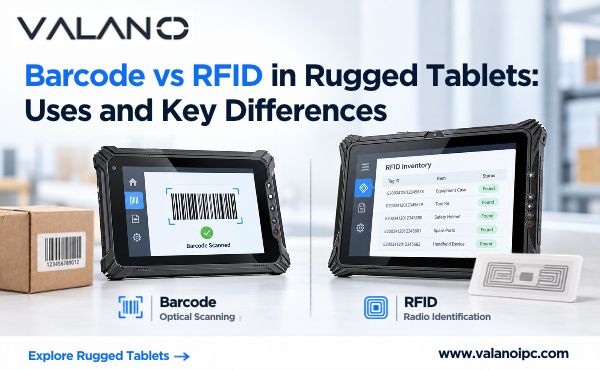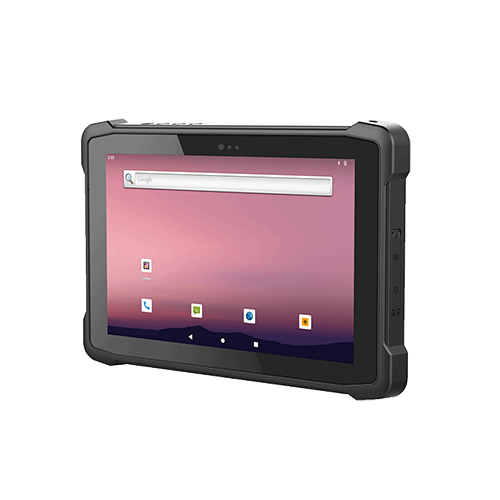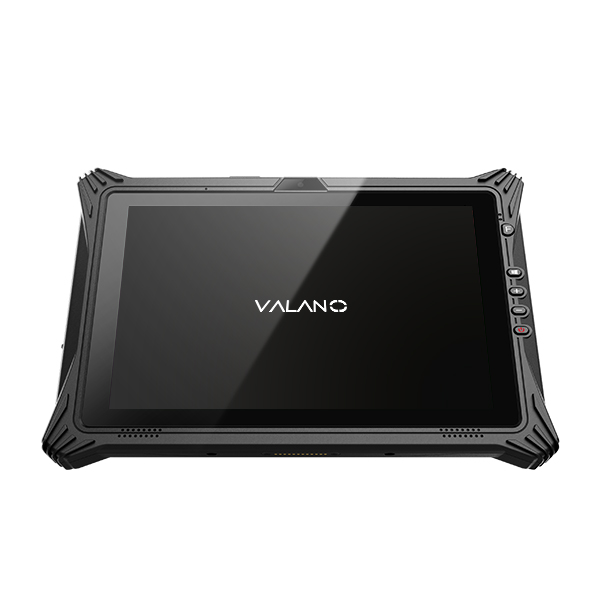
Barcode scanning usually fits deliberate identification of a visible label, such as confirming a picked item or recording a machine serial number. RFID can identify compatible tagged objects without direct optical visibility, and some RFID systems support reading multiple tags during an inventory operation. The best choice depends on the transaction you need to record, not simply the fastest advertised reader.
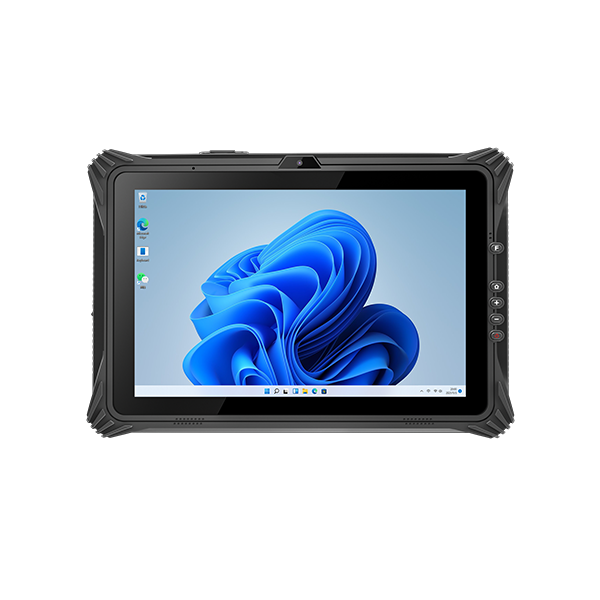
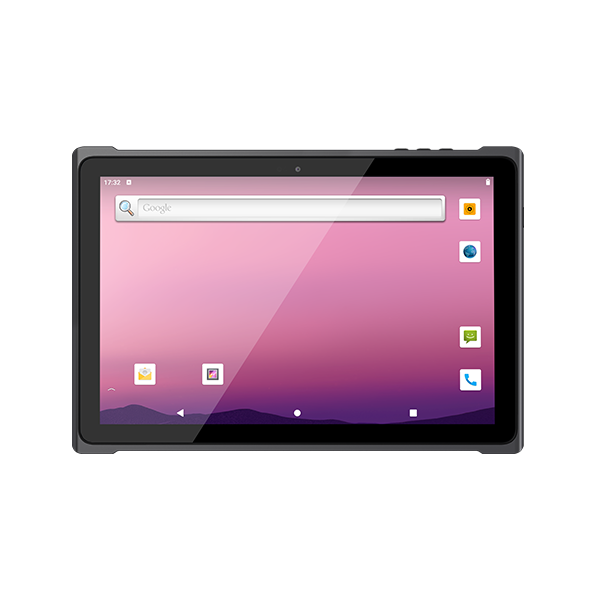
For industrial tablets, the comparison involves labels or tags, reader hardware, application integration and operational control. A tablet with NFC does not automatically support UHF inventory scanning, and a camera does not necessarily replace a dedicated barcode imager in repetitive work.
Barcode and RFID Data Capture
A barcode stores information in an optical pattern. The scanner must capture a usable view of that pattern and decode a supported symbol. Both one-dimensional and two-dimensional barcodes are common, but the required symbologies should be specified rather than assumed from a generic scanner description.
RFID uses radio communication between a reader and a compatible tag. Passive tags normally draw the energy needed for communication from the reader’s field. The readable distance depends on the RFID technology, reader configuration, antenna, tag and environment.
Neither method automatically updates inventory. The application must interpret the identifier, associate it with the correct object and submit a valid business event. Reading an item is different from receiving it, moving it or confirming its shipment. That distinction is central when comparing barcode vs RFID in rugged tablets.
Workflow Differences and Appropriate Uses
| Task | Barcode approach | RFID approach |
|---|---|---|
| Confirming one selected item | Deliberate scan of the chosen label | Requires control over which tag is accepted |
| Counting many tagged assets | Individual scans or a supported multi-code workflow | UHF inventory can capture multiple compatible tags |
| Identifying a concealed label | Requires repositioning or label access | May work without optical visibility, subject to radio conditions |
| Using existing supplier labels | Often practical where supported barcodes already exist | Requires compatible tags and agreed identifiers |
| Keeping a fallback method | Human-readable text can support manual entry | A printed barcode on the RFID label can support optical fallback |
Barcode scanning is useful when the operator must prove selection of a particular carton, component or location. That intentional action can be valuable even when another technology could collect identifiers faster.
UHF RFID is attractive when individual scanning consumes substantial effort and objects already have suitable tags. However, reading more objects is not always the desired outcome. A picking application may need one confirmed item, while a cycle count needs a controlled set of items within a defined area.
RFID Types and Tablet Reader Options
NFC, HF and UHF RFID
NFC operates within the high-frequency family and is commonly associated with close interaction. It can suit tapping an equipment tag, reading a compatible credential or starting a specific inspection workflow. It should not be treated as a substitute for a long-range UHF reader.
Passive UHF RFID, often called RAIN RFID, is widely used for inventory and asset identification. Its radio behavior and tag standards differ from NFC. When a product page lists RFID, request the frequency family, supported protocols, reader model and compatible tag types.
Avoid comparing headline read distances across different RFID technologies. Define the intended distance and object arrangement first. A reliable close-range equipment tap and a pallet inventory sweep solve different problems and need different acceptance tests.
Integrated Modules and External Readers
An integrated reader can reduce the number of separate devices carried by the worker. An external reader may offer a different antenna arrangement, trigger position or battery capacity. Compare the complete assembly, including weight, grip, cables and protective accessories.
Check whether the module is available in the exact tablet configuration. Some expansion options share a physical slot, so selecting RFID could affect another requested interface. For external readers, confirm the connection method, reconnection behavior and software support on the chosen OS.
Barcode Imagers and Camera Scanning
Camera-based scanning can be sufficient for occasional identification when labels are accessible and the software supports the required codes. For frequent scans, evaluate a dedicated imager with appropriate aiming, trigger controls and feedback. There is no universal performance advantage without testing the actual labels and working conditions.
Specify label size, scan distance, mounting position and expected damage. Include curved surfaces, reflective packaging and poorly printed labels in the pilot where those conditions occur. A scanner that works on a clean sample at a desk may struggle with the same identifier on a dusty carton at reach height.
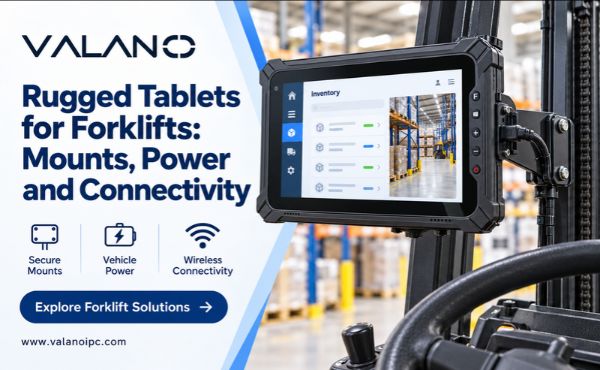
For forklift operations, tablet placement may make the integrated reader awkward to aim. A separate wired or wireless scanner can be more practical. Evaluate reach and operator movement instead of selecting integration merely to reduce the accessory count.
Read Reliability and Environmental Limitations
Barcodes need a readable optical path. Dirt, abrasion, insufficient contrast or obstructed labels can prevent decoding. Choose label materials and placement for the service environment, and define a recovery process for unreadable identifiers.
RFID also has physical limits. Metal can alter antenna behavior, and liquid-containing objects can affect UHF performance. Appropriate on-metal tags and application-specific designs can address some challenges; the correct response is testing suitable tags, not declaring RFID unusable around all metal.
RFID pilots should also test unintended reads. Nearby racks, adjacent pallets and repeated passes can produce identifiers outside the intended transaction. Adjust antenna position and reader settings, then apply application-level filtering and duplicate handling. Increasing reader power is not automatically an improvement if it expands the reading area beyond the task.
Software Integration and Deployment Cost
Barcode readers may deliver decoded data as keyboard input or through an SDK or middleware. Keyboard input can simplify a form but provides less context unless the application adds validation. Test focus control so that a scan cannot enter the wrong field unnoticed.
RFID applications typically need to handle a stream of tag observations. The software must distinguish raw reads from unique items and determine when an inventory session starts and ends. 5 Confirm reader SDK compatibility and the mapping between tag identifiers and your asset or product records.
Calculate deployment cost beyond the tablet module. Include tag or label production, encoding, application work, reader accessories, damaged-label replacement and operator training. If suppliers already apply standardized barcodes, retagging every item may be a major change. RFID is most persuasive where its workflow benefit justifies that additional infrastructure.
Pilot Metrics for a Useful Comparison
Evaluate the complete transaction rather than the number of reads displayed by a demonstration application. For both methods, record:
- Time to complete the intended picking, counting or inspection task.
- Missed items and incorrectly accepted items.
- Repeated submissions and reconciliation effort.
- Operator handling, fatigue and access to labels or tags.
- Recovery after damaged identifiers or lost connectivity.
Use representative objects and a known reference count. An RFID session showing many reads can still miss one critical asset, while a fast barcode scan can still submit the wrong location. Acceptance criteria should match the business consequence of those errors.
Conclusion
Select barcode or RFID capture around the event your workers need to confirm. Barcodes support deliberate identification, while suitable RFID systems can reduce individual handling during inventory. Validate the reader, identifiers and software together, with error control and recovery included in the purchasing decision.