Industrial computers are expected to operate where office computers may fail: beside vibrating machinery, inside electrical cabinets, on moving vehicles, or in locations exposed to dust and temperature fluctuations. Their reliability does not come from one rugged component. It depends on how the enclosure, cooling system, circuit board, power input, storage, connectors, and software-support lifecycle work together.
Specifications such as “fanless,” “wide temperature,” or “MIL-STD tested” can be useful, but they should not be evaluated in isolation. A system may have a rugged enclosure but still use connectors that loosen under vibration. Another may support a wide input voltage but lack protection against transient surges.
The following eight factors explain how industrial computer design affects long-term reliability and what engineers and procurement teams should verify before selecting a system.
1. Thermal Management Under Real Operating Loads
Excessive heat accelerates component aging and can cause processor throttling, unexpected shutdowns, storage errors, or unstable communication. However, thermal reliability cannot be judged by enclosure temperature alone. Engineers must consider processor power, internal component placement, ambient temperature, airflow, mounting orientation, and the workload running on the system.
Fanless Cooling and Enclosure Design
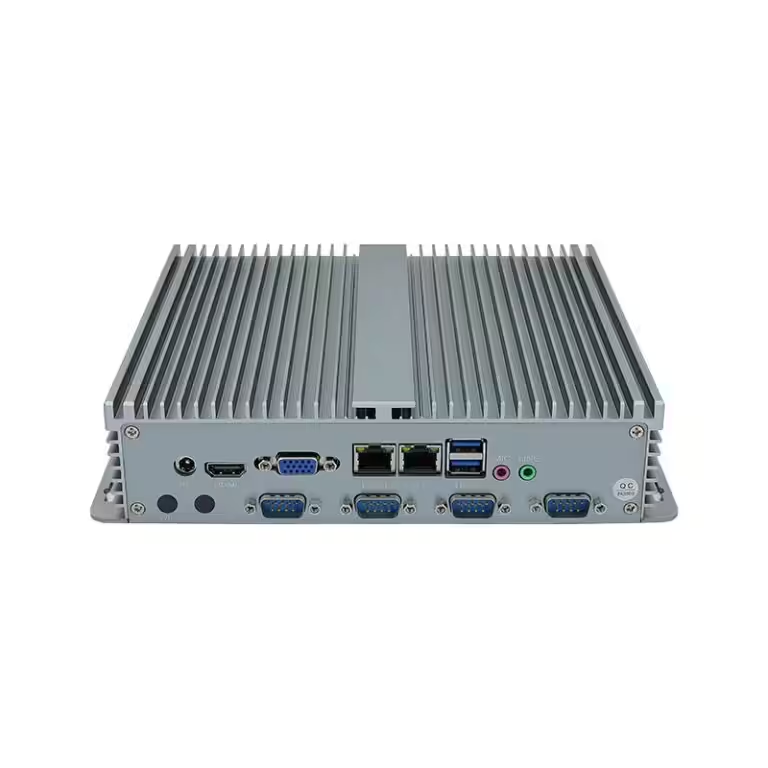
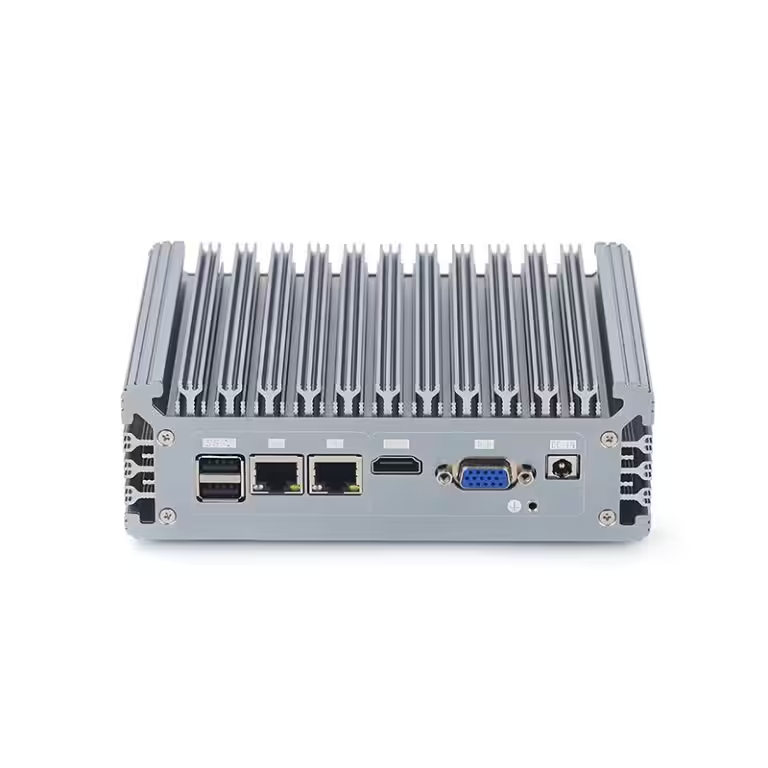
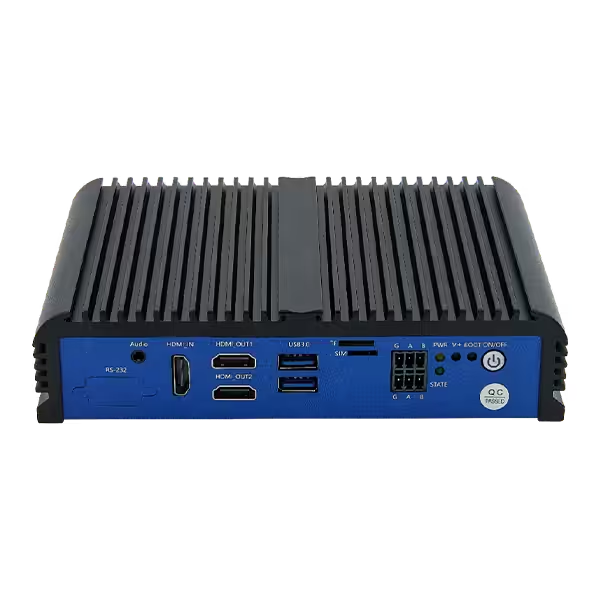
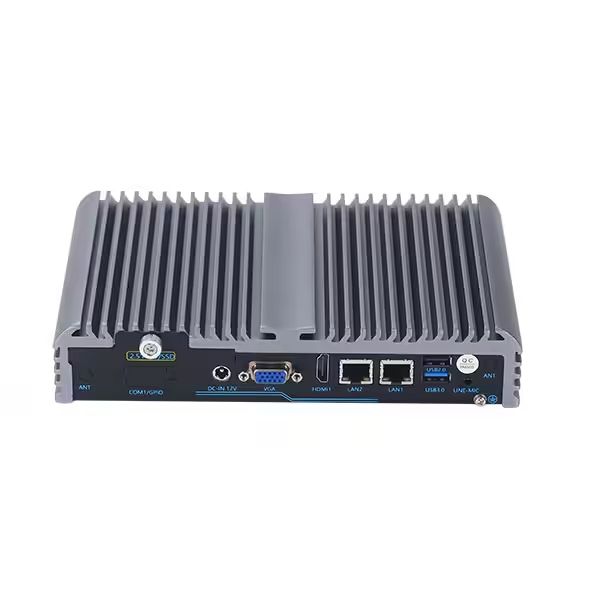
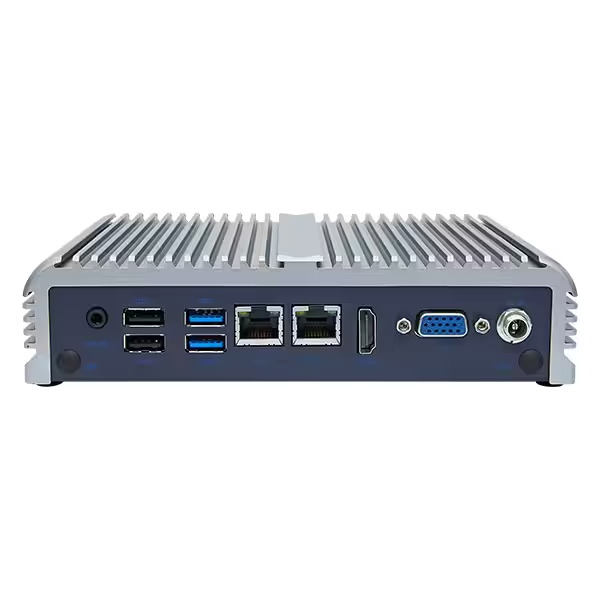
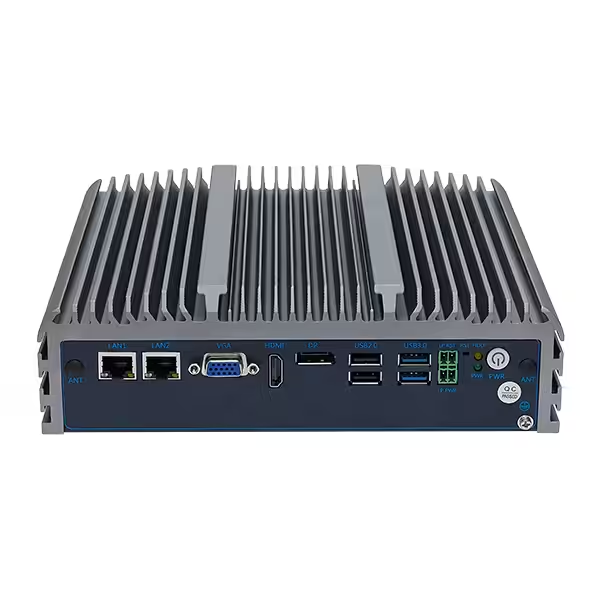
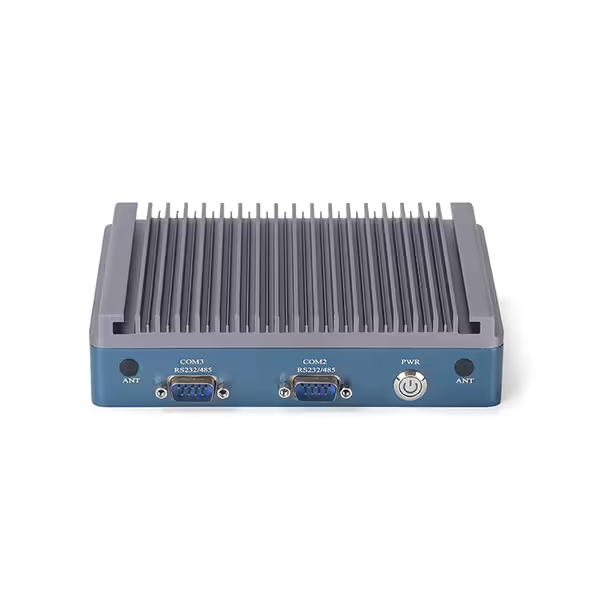
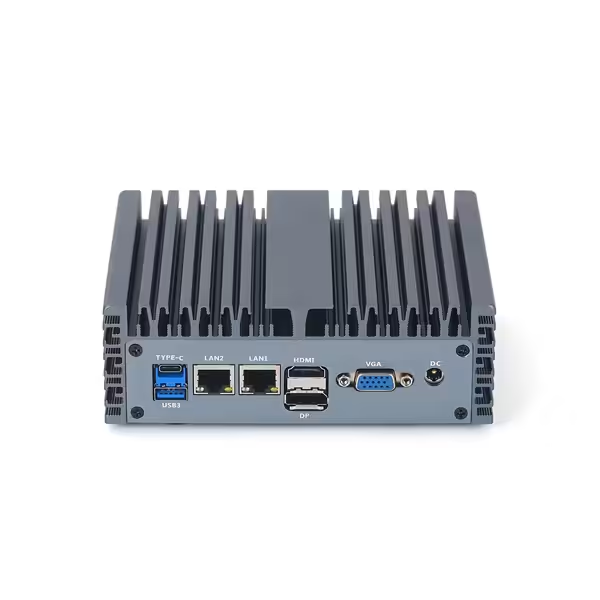
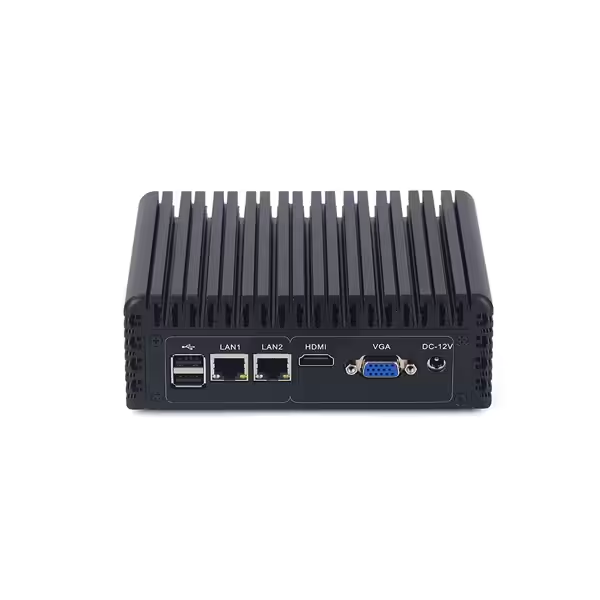
Many industrial computers use fanless cooling to reduce moving parts and limit dust intake. Heat travels from the processor and other high-temperature components through thermal interface materials to the metal enclosure, which functions as a heat sink.
An effective fanless design requires:
- Sufficient contact between heat-generating components and the enclosure
- Appropriate heat-spreader and heat-sink dimensions
- Internal spacing that prevents localized hot spots
- Suitable thermal interface materials
- Adequate clearance around external cooling fins
- Validation under sustained CPU, GPU, and storage workloads
Fanless construction does not automatically mean that a computer is sealed or suitable for every dusty environment. The protection level still depends on enclosure seams, connectors, cable entries, and the verified ingress protection rating.
Understanding Operating-Temperature Specifications
A published operating range such as –20°C to 60°C or –40°C to 70°C must be read together with its test conditions. Buyers should determine whether the range applies to the complete system or only selected components.
Important questions include:
- Was the system tested under full computational load?
- Which processor and storage configuration was used?
- Was airflow provided around the enclosure?
- Does performance decrease near the upper temperature limit?
- Does the cold-start temperature differ from the operating temperature?
- Do all installed components support the same temperature range?
A computer should be selected according to the worst expected enclosure temperature, not only the average room or outdoor temperature.
2. Resistance to Vibration and Mechanical Shock
Continuous vibration can loosen connectors, damage solder joints, wear cables, or cause socketed components to move. Short mechanical shocks may deform mounting points or interrupt electrical contact even when the enclosure remains intact.
Industrial computer designs may improve mechanical reliability through:
- Locking or screw-secured connectors
- Reinforced PCB mounting points
- Cable retention and strain relief
- Soldered or securely retained memory
- M.2 storage secured with appropriate fasteners
- Support brackets for heavy PCIe cards
- Vibration-resistant terminal blocks
- Mechanically reinforced internal components
Storage without moving parts removes the mechanical vulnerability of hard disk drives, but an SSD alone does not make the entire computer vibration-resistant.
Test reports should identify the vibration profile, frequency range, acceleration, duration, axis, and operating state. A general statement such as “MIL-STD-810 tested” is incomplete because the standard contains different methods and procedures that must be tailored to the intended environment.
The expected vibration from a machine frame, rail vehicle, mobile robot, or mining vehicle should be compared with the actual test conditions of the computer.
3. Protection Against Dust, Water, and Contaminants
Dust can insulate heat-generating components, obstruct airflow, and create conductive paths on circuit boards. Moisture may cause corrosion, leakage current, or short circuits. Oil mist, salt, cleaning chemicals, and metal particles create additional risks that are not fully described by a basic “rugged” label.
Ingress protection ratings provide a structured way to evaluate resistance to solids and liquids, but the exact scope must be verified.
For example, a Panel PC may have an IP65-rated front panel after proper installation while its rear enclosure and connectors have a lower protection level. A Box PC with a fanless enclosure may still have exposed I/O ports that prevent the complete system from reaching the same rating.
Procurement teams should confirm:
- Whether the rating applies to the full enclosure or only the front panel
- Whether connectors must be covered or mated during testing
- Whether the rating applies before or after panel installation
- Whether cable glands and accessories are included
- Whether resistance to oil, salt fog, or cleaning chemicals is separately tested
Conformal coating may protect PCB surfaces against moisture, dust, and corrosive contaminants. It does not replace a properly sealed enclosure and should not be treated as the primary solution for mechanical vibration.
4. Stable Power Input and Electrical Protection
Industrial power sources can be affected by voltage fluctuations, motor switching, incorrect wiring, and sudden power interruption. Vehicle-mounted computers may also experience cranking voltage drops and load-dump transients.
A wide DC input range helps a computer operate from different power systems, but the voltage range alone does not describe the full level of protection. Reliable power design may include:
- Overvoltage protection
- Undervoltage protection
- Reverse-polarity protection
- Overcurrent and short-circuit protection
- Surge and transient suppression
- Galvanic isolation where required
- Ignition control for vehicle installations
- Controlled shutdown or power-loss protection
Buyers should compare the computer’s power-protection specifications with the actual electrical environment. A 9–36 VDC input, for example, does not automatically confirm that the system can survive every surge occurring on a 24 V vehicle or factory power bus.
Sudden power loss is particularly important for systems that continuously write production records, images, or database files. Operating-system configuration, SSD power-loss protection, and application-level data handling should be considered together.
5. Industrial-Grade Components and Product Availability
Industrial computer deployments may remain in service for many years. During that period, a replacement unit may need to run the same software image, connect to the same equipment, and maintain the same physical installation.
Reliability therefore includes configuration continuity, not just resistance to environmental stress.
Long-term platform planning should cover:
- Processor and chipset availability
- Memory and storage compatibility
- Network controller continuity
- Operating-system and driver support
- BIOS and firmware maintenance
- Product-change notifications
- Revision-control policies
- Form-fit-function replacement options
“Industrial-grade component” should not be treated as a complete technical specification. Temperature rating, endurance, voltage tolerance, supplier lifecycle, and validation conditions are more useful than the label itself.
When exact configuration continuity is important, buyers should ask how the manufacturer handles component substitutions and whether approval is required before changing storage, memory, LAN controllers, or other critical parts.
6. EMI and EMC Performance
Variable-frequency drives, motors, relays, welding equipment, radio transmitters, and high-current cables can generate electromagnetic interference. Poor immunity may cause communication errors, system resets, unstable I/O signals, or corrupted measurements.
Reliable electromagnetic compatibility depends on several parts of the design:
- Conductive enclosure construction
- Proper bonding between enclosure sections
- Ground-plane and PCB layout
- Filtering on power and I/O lines
- Shielded cables and connectors
- Separation of sensitive signals from noisy circuits
- Correct grounding during installation
Compliance with an emissions standard does not automatically demonstrate adequate immunity in a factory environment. The applicable standards and test levels should reflect the intended installation.
Installation also matters. A computer that performs correctly in a laboratory may still experience problems if shielded cables are terminated incorrectly, signal lines run beside motor cables, or the equipment cabinet has poor grounding.
7. Storage, Memory, and Data Integrity
Storage reliability depends on workload as much as hardware type. A system that stores occasional configuration files has different requirements from a machine-vision computer that continuously writes images or a data-acquisition system that records measurements around the clock.
When evaluating industrial SSDs, consider:
- NAND type and endurance rating
- Total bytes written or drive writes per day
- Operating-temperature range
- Power-loss protection
- Error-correction capability
- Write amplification
- Over-provisioning
- Health monitoring
- Availability of fixed configurations
SLC or pSLC storage may provide higher endurance, but it is not required for every application. The correct choice depends on write volume, retention requirements, temperature, service life, and acceptable replacement intervals.
ECC memory can improve protection against memory errors when supported by the processor, chipset, motherboard, and firmware. Common SECDED implementations correct single-bit errors and detect double-bit errors, but capabilities vary between platforms. ECC should therefore be verified as a complete system function rather than assumed from the memory module alone.
8. Validation, Testing, and Traceable Specifications
A reliable design must be supported by evidence. Environmental and electrical testing helps identify weak thermal interfaces, unstable power behavior, loose connections, material problems, and insufficient design margins before deployment.
Relevant validation may include:
- High- and low-temperature operation
- Cold-start testing
- Thermal cycling
- Vibration and mechanical shock
- Humidity exposure
- Dust and water ingress testing
- Electrostatic discharge
- Radiated and conducted immunity
- Power interruption and surge testing
- Burn-in or production screening
HALT can help expose design weaknesses by testing beyond normal operating limits, while production burn-in may help screen early component failures. These methods serve different purposes and should not be presented as interchangeable certifications.
When reviewing a specification, buyers should ask for the test standard, procedure, severity, duration, system configuration, and pass criteria. Test conditions are more informative than an unsupported statement that a product is “rugged certified.”
How to Evaluate Industrial Computer Reliability
The most reliable industrial computers are not necessarily the models with the highest individual specifications. They are the systems whose design and verified limits match the actual deployment.
Before selecting a configuration, document:
- Minimum and maximum operating temperatures
- Expected processor and GPU loads
- Vibration and shock conditions
- Dust, moisture, oil, or chemical exposure
- Available power source and possible transients
- Required interfaces and connector retention
- Continuous storage-write volume
- Maintenance access
- Required service life and configuration availability
- Applicable safety and EMC requirements
These conditions should then be mapped to the computer’s test evidence and configuration-specific specifications.
Industrial computer reliability is the result of coordinated thermal, mechanical, electrical, and lifecycle decisions. Evaluating these eight factors together helps prevent overspecification in controlled environments and, more importantly, avoids choosing systems that meet one headline requirement while leaving another field risk unaddressed.